How to Trade Meme Coins With a $10 Bankroll in 2026 Without Fees Eating You Alive
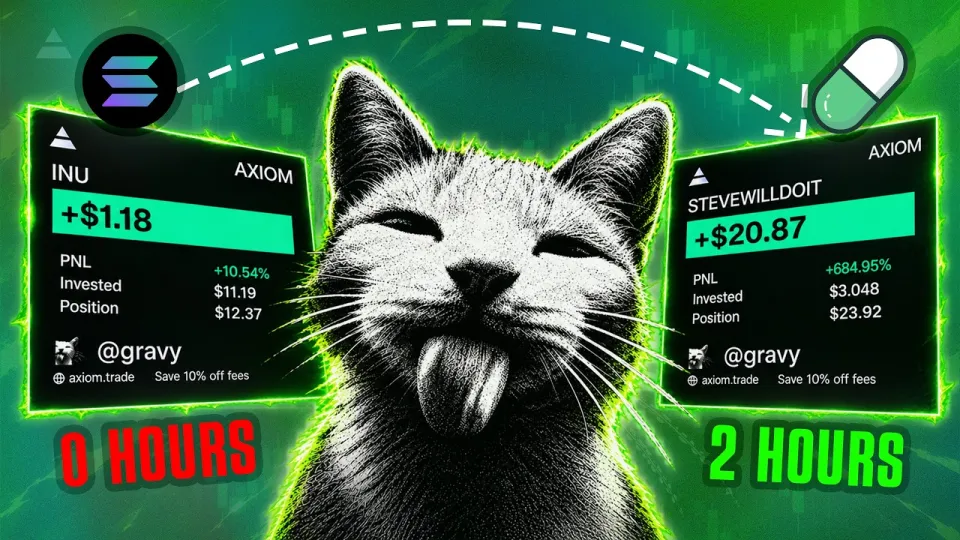
Video: I Tried Trading Memecoins with Just $10
Want articles like this for your own video to promote it on YouTube and Google? Order them through the Telegram bot @sat_sit_bot. Articles with your video embedded are written and posted by the bot itself — on popular topical sites (no ads). Free trial — 50 articles.
· based on the channel gravy
Key takeaways
- Five trades, none larger than 0.05 SOL per buy — roughly $10 total working capital on Solana.
- Tickers covered: STEVEWILLDOIT, NPC, MET (Meteora), PUMPY the Trader and UNTXD.
- The X Money coin meta ran on the e/acc and Cream narrative, not on product news.
- Fees and slippage, not position size, are what break sub-$50 accounts.
- The trader fumbled one of the five entries — a reminder that execution matters more than the pick.
Can you trade meme coins with $10? Yes — but only if every buy stays small enough that fees and slippage cannot eat the position, which in practice means keeping each entry under 0.05 SOL and treating the $10 as a set of five or six separate bets rather than one trade. That is exactly the experiment the trader "gravy" ran in a five-trade test on Solana, routing orders through Axiom's trading terminal, where the referral link gives double cashback and a 15% fee reduction. The result is a useful template for anyone with a low balance: the constraint is not the size of the bankroll, it is the discipline of the exits.
What a $10 meme coin bankroll actually buys on Solana
A $10 bankroll on Solana is not one position, it is a series of micro-positions, and the math only works if you size them that way. At a SOL price in the low hundreds of dollars, 0.05 SOL is a handful of dollars, so five entries of that size leave room for one or two re-entries after a stop-out. The reason small accounts die is not the trade idea — it is that a $10 buy paying a 1% platform fee plus priority fee plus slippage on both sides can start down 4–8% before the chart moves at all. Keeping tickets small and round-tripping quickly is what keeps that drag survivable.
Practical sizing rules that follow from this:
- Cap every buy at 0.05 SOL so no single rug can end the session.
- Never add to a loser — with a $10 stack, averaging down is just a slower liquidation.
- Take partial profit into the first vertical candle instead of waiting for a round number.
- Count fees as part of the entry price, not as a separate cost you will "make back later."
The five trades and the narratives behind them
The five tickers in the test — STEVEWILLDOIT, NPC, MET, PUMPY the Trader and UNTXD — were chosen for narrative, and narrative is the only edge a retail trader with $10 genuinely has. In the video the first buy is STEVEWILLDOIT, a coin riding a well-known internet meme format; the second is NPC, which leans on the same irony-driven meta; MET is tied to Meteora, a real Solana liquidity protocol, which gives it a hook beyond pure meme status; PUMPY the Trader plays on the pump.fun trading culture itself; and UNTXD is the more speculative, lower-liquidity pick. Each entry was justified before the click, not after.
The most instructive part of the description is the aside on why the X Money coin meta ran: the move was driven by the e/acc and Cream crowd, meaning a specific online subculture decided the ticker was worth bidding, not by any product announcement. That is the mechanic to internalise — a meme coin pumps when a coherent group with a shared vocabulary adopts it, and it dies when that group moves to the next ticker.
Why narrative selection beats chart reading at this size
Narrative selection is the whole game for a small portfolio, because technical analysis on a token with a few hours of history and thin liquidity is mostly noise. A $10 trader cannot move price, cannot see order flow, and cannot out-latency snipers, so the only repeatable advantage is noticing a story early — a phrase spreading on X, a protocol name being memed, a community forming around a joke — and getting in before the crowd that will provide your exit liquidity.
That has a cost: screening is time-consuming. You have to read timelines, remember who actually has reach in a given community, and distinguish a real subculture adoption from a paid shill. A useful filter is to ask whether the joke works without the chart. If you cannot explain the ticker to someone in one sentence and have them laugh or nod, you are probably the exit liquidity.
The exit problem that ruins most small meme coin trades
The exit is where small meme coin traders lose money, not the entry, and the pattern is consistent: buy a dip, watch the original holders sell into it, panic out at a 20–40% loss, then check back an hour later to find the coin ran without you. That sequence is not bad luck — it is the standard lifecycle of a pump.fun launch, where early wallets distribute into every dip-buyer until the narrative either re-ignites or dies.
Three habits fix most of it:
- Decide the invalidation level before buying, and treat a break of it as information rather than a personal insult.
- Scale out in thirds — one third into the first spike, one third into strength, and let the last third run with a trailing stop.
- Accept that missing a runner after a disciplined stop-out is a normal cost of doing business, not evidence the strategy failed.
Fees, tools and the infrastructure question
Infrastructure choices matter more at $10 than at $10,000, because a percentage fee is the same percentage regardless of ticket size. Trading through a terminal that returns cashback and discounts fees directly changes the breakeven point of every trade, which is why the video routes execution through Axiom rather than a bare wallet swap. Priority fees on Solana are the other hidden line item: paying the minimum can mean a failed transaction during exactly the volatility you wanted to trade, while overpaying quietly eats a meaningful share of a small position.
A separate warning worth passing on: free VPN browser extensions are a bad place to route trading sessions. Several popular free options operate as peer-to-peer networks that log browsing activity and resell bandwidth, which is a poor trade-off for anyone signing transactions with a funded wallet.
Questions small-account traders keep asking
Most of the recurring doubts around meme coin trading with a small balance come down to process rather than picks. Traders want to know how to find narratives without drowning in timelines, why their dip-buys keep failing, and whether a live session with a doxxed wallet would prove anything. The honest answers are unglamorous: build a short list of accounts and communities worth reading daily, assume every dip is being sold into until proven otherwise, and judge a strategy by its risk control rather than by one green screenshot.
One legitimate criticism of the five-trade format is that it shows the individual trades but not the aggregate result, which makes it hard to judge whether the approach nets out positive after fees. Anyone replicating it should track total profit and loss from the first buy, not just the wins.
Useful links
- Axiom trading terminal with referral cashback: https://axiom.trade/@gravy
- The Trenches Discord: https://discord.gg/W7TqkExcSd
- Discord with free Axiom imports and trade signals (not financial advice): https://discord.gg/9W5j3XUgYB
- Trader's X account: https://x.com/gravyski
- Leverage trading with a 20% futures fee reduction: https://www.bitbase.com/landing-page/trading-earning-Gra?ref=8CYOGY
Final takeaway
Trading meme coins with $10 is possible, but the bankroll is not the variable that decides the outcome — position sizing, exit discipline and fee awareness are. The five-trade test from the gravy channel makes the case that 0.05 SOL entries, narrative-first selection and quick partial exits can keep a micro-account alive long enough to learn something, and that the fumbled trade teaches more than the winners. Anyone starting small should begin at Axiom via the referral link to capture the cashback and fee discount, then treat the first ten trades as tuition rather than income.
Source: I Tried Trading Memecoins with Just $10 · Markdown version
Questions & answers
Can you really trade meme coins with only $10?
Yes, on Solana, provided you keep each buy at or below roughly 0.05 SOL and accept that fees and slippage will consume a few percent per round trip. The $10 works as five or six micro-positions rather than one meaningful trade, so the goal is learning and process discipline, not income.
How do I find meme coins with a good narrative without reading every tweet?
Narrow your sources instead of widening them: follow a short list of accounts that are early to subculture jokes, watch which protocol names are being memed, and check whether a ticker's joke works without a chart. If you cannot explain the coin in one sentence, you are probably buying someone else's exit.
Why do my dip buys keep getting sold into?
Because early wallets distribute into every wave of dip-buyers until the narrative re-ignites or dies — that is the normal lifecycle of a pump.fun launch. Set an invalidation level before entering, scale out in thirds, and treat a stop-out followed by a runner as a routine cost rather than proof the method failed.
Do fees make small meme coin trades pointless?
Fees are a real drag but not a disqualifier if you size correctly and use a terminal that returns cashback or discounts fees. The bigger hidden cost is priority fees and slippage on both sides, which is why counting fees as part of the entry price matters more at $10 than at $10,000.